

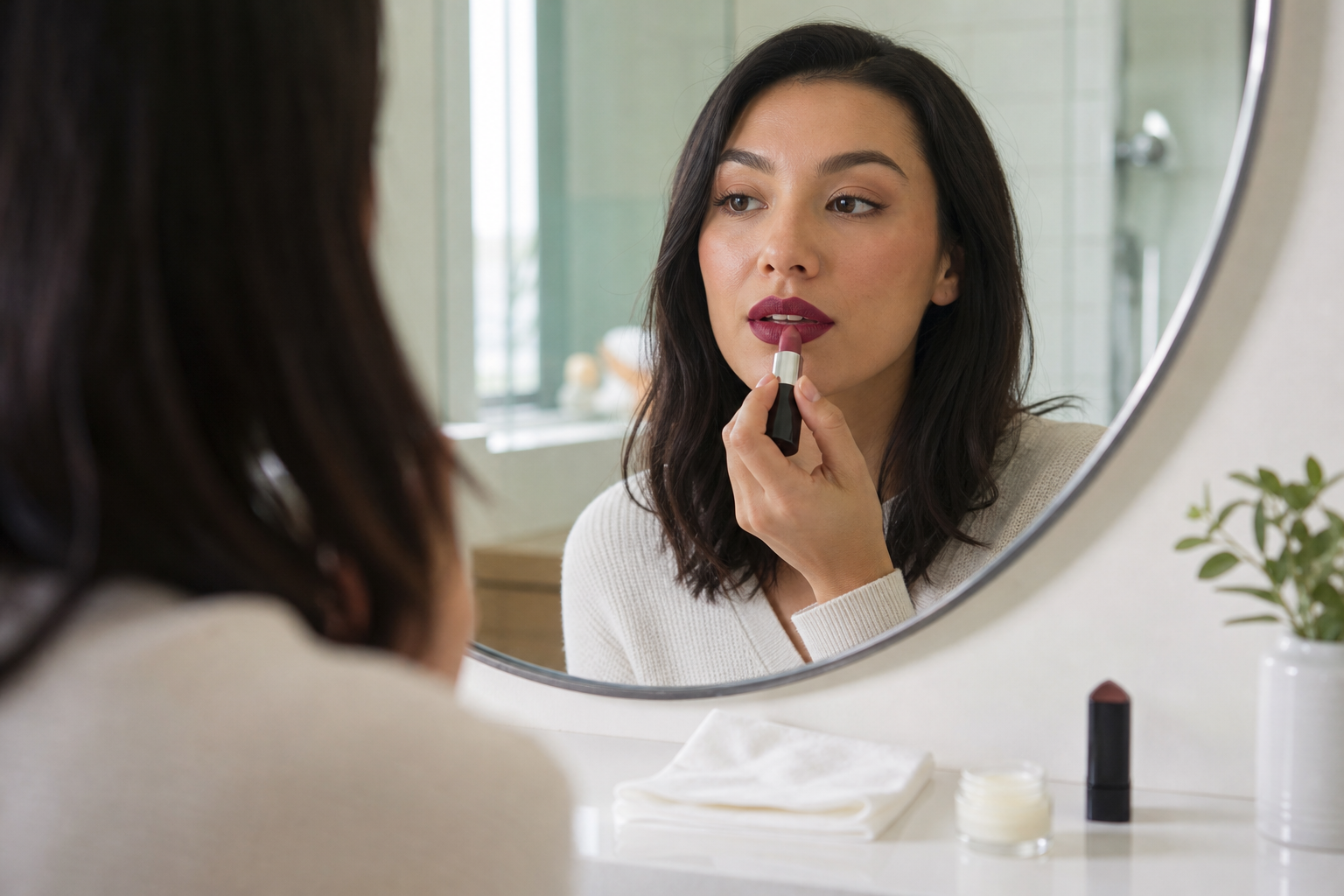
Long-lasting matte lipstick wear depends on more than the lipstick itself. Lip condition, formula, application technique, and friction from eating and drinking all affect how evenly colour lasts.
The most reliable approach is to prepare lightly, apply thin layers, let the colour settle, and touch up only where needed. No technique guarantees identical all-day wear for everyone, but these steps can help reduce patchiness, premature fading, and heavy buildup.

Matte lipstick shows texture more clearly than a glossy or creamy finish. Flaking, deep dryness, or uneven texture can interrupt the colour film and make fading look patchy. However, too much balm or facial oil can also make colour move more easily.
Formula matters too. Some matte products are flexible and comfortable, while others set more firmly to reduce movement. A firmer formula may resist transfer more effectively, but it can feel drier. A softer matte may feel better but require more care around meals.
Application thickness is another important variable. A heavy layer can remain tacky, gather in lip lines, or break down unevenly. Thin layers generally provide more control and make targeted touch-ups easier. Hot drinks, oily food, napkins, repeated rubbing, and lip licking can all disturb colour. These are normal wear conditions, not necessarily evidence that a product has failed.

Decide which type of wear matters most for the occasion. A comfortable matte may be preferable for a long day when you want flexibility and less tightness. A firmly setting formula may be more useful when reducing visible transfer is the priority.
| Priority | What to look for | Likely tradeoff |
|---|---|---|
| Comfort | A flexible matte feel without excessive tightness | More movement or touch-ups may be needed |
| Lower transfer | Clear transfer-resistant or setting claims | Greater risk of dryness or stiffness |
| Even fading | A formula and shade that fade without a strong outline | It may not resist oily food as strongly |
| Easy touch-ups | A colour that can be reapplied without buildup | It may need refreshing after meals |
These are general patterns, not guarantees. Lip condition, shade, application amount, and product instructions all influence the result.
Remove previous lipstick, gloss, and oily residue. A clean surface helps you see your natural lip texture and prevents old product from mixing with the fresh layer.
If your lips have loose, dry texture, use a gentle method rather than aggressive scrubbing. Over-exfoliating can leave lips feeling more sensitive. If there is no visible flaking, skip this step.
Apply a small amount of lip moisturiser and allow it to settle. For a smoother base, a lip plumper described as providing long-lasting moisture can be used, but it should absorb fully before matte colour is applied.
If your lips still feel slippery, press a tissue lightly against them. The goal is comfortable, conditioned lips without a thick layer of balm or oil that could interfere with adhesion.
Use the lipstick or a compatible lip pencil to establish the shape. Pay attention to the corners, where product can gather or fade first. Avoid creating a thick outline simply to imitate longer wear.
Start at the centre and work outward, keeping the layer even. A thin coat gives the product a better chance to settle and leaves room for a controlled second layer.
Press your lips together once or twice to distribute colour, but avoid vigorous rubbing. Excess movement can push product beyond the lip line.
Blotting can remove excess product, but it is not necessary for every formula. If the lipstick already feels thin and even, blotting may remove too much colour. If it feels heavy or mobile, press gently with a tissue.
Let the first layer settle briefly, then add colour only where coverage is missing. Repeatedly coating the entire mouth is more likely to create cracking, buildup, or uneven texture.
A primer may help when it is compatible with the intended finish, but it cannot replace lip preparation. Check that it is designed to support a matte finish rather than add excess slip.
Matte lipstick commonly fades first from the inner lip, where moisture and food make the most contact. The outer edges may remain more visible, making the colour look uneven even when the original application was balanced.
| Situation | What to do |
|---|---|
| Coffee or water | Use the rim carefully and refresh only if colour has visibly lifted. |
| Oily meal | Blot gently, remove residue from the inner lip, and reapply a thin layer. |
| Dry or patchy centre | Remove loose product, add minimal moisture if needed, then reapply sparingly. |
| Faded edges | Redefine the outline first, then fill toward the centre. |
Do not apply fresh lipstick over food, oil, or loose flakes. If the whole application has broken down, removing it and starting again may look better than continually adding colour.
Product descriptions may use terms such as long-wearing, long-lasting, transfer-resistant, smudge-resistant, or a specific number of hours. Treat these as product-specific expectations, not guarantees for every wearer.
Look for details about finish, recommended application, removal, and the conditions behind the claim. Your meals, lip condition, climate, and habits can produce a different result.
In Canada, cosmetic advertising and labelling claims must be accurate and not misleading. Health Canada explains that wording, images, symbols, and implications can shape the overall impression of what a product does. Read the complete description rather than relying on one strong phrase. Health Canada’s cosmetic advertising guidance provides relevant context.
The Canadian Cosmetic Regulations also require evidence for claims about a cosmetic’s ability, or its ingredients’ ability, to influence skin chemistry. For shoppers, the practical lesson is to distinguish a clear wear description from an absolute promise.
Oria Botanica positions its branded collection as clean beauty, cruelty-free, and made in North America, with skincare, cosmetics, makeup, and beauty tools available online. These preferences can narrow your search, but a lipstick’s specific wear and comfort should be assessed from its own product information.
For a focused shopping comparison, see these long-lasting matte lipstick picks.
Too much moisturiser, balm, or oil can add slip. A light layer that absorbs can improve comfort, but excess residue should be removed before application.
Not always. Blot gently only when the first coat feels heavy or mobile, since blotting a thin coat may remove too much colour.
Yes, although maximum transfer resistance and comfort often involve a tradeoff. Flexible formulas and thin application can support comfort, while firmer formulas may prioritise reduced movement.
Transfer-resistant generally refers to how much product moves onto another surface. Long-wearing is broader and may describe how long colour remains visible, even with some transfer or fading.
Blot away oil and remove loose residue first. Refresh the inner lip or faded edges with a thin layer instead of coating the entire mouth.
Better matte lipstick wear comes from matching the formula to your priorities and controlling the application. Prepare lightly, remove excess oil, build thin layers, and manage meals and touch-ups without repeatedly coating the whole mouth.
If comfort is your priority, accept that a flexible matte may need refreshing. If transfer resistance matters more, read the exact claims and accept that a firmer finish may feel less comfortable.
To explore a clean beauty range that includes cosmetics, skincare, and makeup essentials, visit Oria Botanica.