

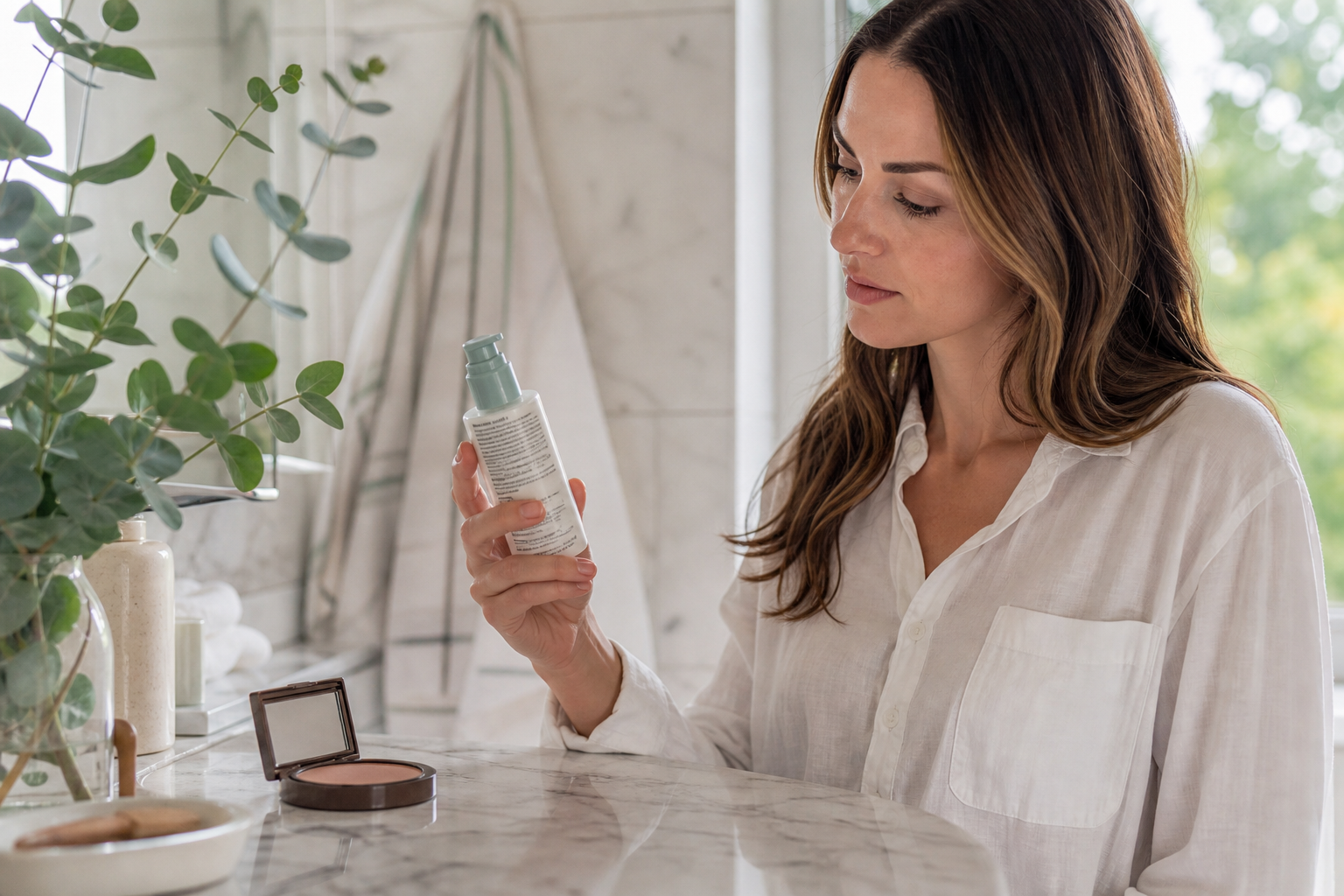
Choosing clean beauty products involves more than looking for words such as “natural” or “botanical” on the front of a package. The most reliable starting point is the complete cosmetic label, followed by a careful look at fragrance disclosure, warnings, product identity, and the evidence behind each marketing claim.
For Canadian shoppers comparing skincare and makeup, this seven-point checklist separates information a label can verify from assumptions it cannot support. It can help you compare botanical skincare, organic skincare, and natural makeup more confidently without treating any broad claim as an automatic promise of safety or performance.
The ingredient list is the most useful place to begin when comparing clean beauty ingredients. In Canada, cosmetic labels must use the International Nomenclature of Cosmetic Ingredients, or INCI, for ingredient disclosure. Health Canada also explains that ingredient information helps consumers identify and avoid ingredients that may concern them. Health Canada’s cosmetic labelling requirements provide the broader list of information shoppers should expect.
Do not rely on a product name, a botanical image, or a short list of featured ingredients as a substitute for the full list. The complete INCI list may include cleansing agents, emollients, preservatives, colourants, fragrances, and other formulation components that are not mentioned in the headline claim.
Also avoid drawing conclusions about concentration, effectiveness, or personal suitability from an ingredient name alone. A list can tell you what is present, but it does not by itself establish that a product will produce a particular result for every person.

Fragrance deserves a separate check because it may not appear as a familiar list of individual scent materials. Health Canada notes that terms such as “parfum” or “fragrance” can indicate a fragrance or masking agent in a cosmetic ingredient list. Health Canada’s guidance on cosmetic advertising and ingredients explains this terminology.
This does not mean fragrance is automatically unsuitable for everyone. It means shoppers who prefer fragrance-free products, or who already know they need to avoid particular fragrance-related ingredients, should look for clear disclosure rather than assuming that “botanical” or “clean” means fragrance-free.
When comparing two products online, record the exact wording used in each ingredient list. “Fragrance-free,” “unscented,” and a product that simply does not highlight fragrance are not interchangeable descriptions, so check the full label and any applicable cautions.
A clean beauty label should make clear what the product is and how much it contains. Canadian cosmetic labelling requirements include the product identity, net quantity in metric units, contact information, an ingredient list, and applicable warnings or cautions. These details help you understand what you are purchasing before you focus on the promotional language.
For skincare, confirm whether the item is a cleanser, serum, cream, oil, or another product type. For makeup, check whether it is intended for the lips, eyes, face, or cheeks. Product identity matters because an ingredient list should be interpreted in the context of how the formula is intended to be used.
Online shoppers should look for the same information on the product page or packaging photographs. If the quantity, directions, warnings, or contact details are missing, treat that as a reason to seek clarification before ordering rather than filling in the gaps from the product name.
“Clean,” “natural,” “botanical,” and “organic” may all appeal to ingredient-conscious shoppers, but they should be assessed separately. None of these words alone tells you the complete formula, the concentration of a featured ingredient, the presence of fragrance, or whether the product will suit your skin.
Ask a different question for each claim:
For a helpful introduction to plant-focused product terminology, you can review these botanical skincare basics. The important shopping principle is to connect the claim to specific label information rather than treating a positive-sounding descriptor as proof of universal safety or superior results.
Ethical and origin claims answer different questions from ingredient claims. “Cruelty-free” generally addresses a brand’s animal-testing policy, while “made in North America” describes a production location or manufacturing claim. Neither statement, on its own, gives you the complete ingredient list or confirms that a product is vegan.
Oria Botanica states that its branded cosmetics are cruelty-free and not tested on animals. The brand also states that its entire branded line is made in North America. These are relevant considerations for shoppers who value animal-testing policies and regional production, but they should still be considered alongside the product’s own ingredient information, directions, and warnings.
For a closer look at the questions to ask about regional production claims, see what to check before buying made in North America beauty. Manufacturing origin may be meaningful to your purchasing decision, but it does not automatically prove superior safety, sourcing, or performance.
The best clean beauty ingredients for one product category may not be the deciding factor in another. A cleanser is used and rinsed differently from a serum. A moisturiser is judged by its texture and intended role, while makeup may require closer attention to colourants, application area, and removal instructions.
Start with your actual purpose. If you are comparing cleansers, check how the product is intended to be used and whether the full label meets your personal ingredient preferences. If you are comparing serums or creams, look at the complete formula, directions, warnings, and any ingredients you already know you avoid. For makeup, confirm that the product is intended for the area where you plan to use it.
Product names cannot establish vegan status, concentration, allergy suitability, or guaranteed results. If you have a known allergy, persistent irritation, or a medically diagnosed skin condition, use your existing professional guidance when deciding which ingredients to avoid.
A broader routine perspective can also prevent overbuying. This explanation of an organic skincare routine can help you think about how products fit together instead of selecting several items based only on individual claims.
Once you have checked the label, compare what the brand promises with what the available information can actually demonstrate. The table below offers a practical way to do that without dismissing useful claims or accepting them uncritically.
| Label evidence | What it can tell you | What it cannot prove by itself |
|---|---|---|
| Complete INCI ingredient list | Which ingredients are declared in the formula and which ingredients you may wish to avoid | That the product will suit every skin type or deliver a guaranteed result |
| “Parfum” or “fragrance” | That fragrance or a masking agent is disclosed under that terminology | That the product is automatically harmful or unsuitable for every shopper |
| Clean, natural, botanical, or organic wording | How the brand positions the product or selected ingredients | A universal definition, complete safety assessment, or guaranteed efficacy |
| Cruelty-free statement | The brand’s stated position on animal testing | That the product is vegan or free from every ingredient you avoid |
| Made in North America statement | The stated manufacturing region | Superior performance, sourcing, or safety without further evidence |
A useful rule is to give the greatest weight to information you can inspect: the full ingredient list, product identity, quantity, directions, warnings, and a clear way to contact the seller. Marketing language can help you understand a brand’s priorities, but it should not replace those details.
When shopping a cosmetics online store, use the same sequence for every product you are considering. Open the full product details, copy or photograph the ingredient list, note fragrance wording, check warnings and directions, and record the product’s size and intended use. Then compare the claims that matter most to you, such as botanical ingredients, organic standards, cruelty-free policies, or manufacturing origin.
Oria Botanica offers an online range that includes botanical skincare, cosmetics, makeup, and beauty tools. Its collection includes categories such as skincare, face, lips, eyes, cheeks, and tools, which can make it easier to compare products by intended use rather than browsing only by a broad clean beauty label.
If a product page does not provide enough information to answer your questions, contact the seller before purchasing or choose an alternative with clearer documentation. A complete label is more useful than an attractive claim that leaves important details unanswered.
There is not one universal meaning that makes every product labelled “clean” identical. Evaluate the brand’s stated criteria alongside the complete ingredient list, product details, and applicable warnings. Health Canada requires cosmetic ingredient disclosure and other label information, which gives shoppers concrete details to inspect.
No. Botanical describes an ingredient’s plant-related origin, not how every person’s skin will respond. Review the complete formula and any warnings, and use professional advice if you have a known allergy, ongoing irritation, or a diagnosed skin concern.
Health Canada notes that “parfum” or “fragrance” may identify a fragrance or masking agent in the ingredient list. The term deserves attention if you prefer fragrance-free products or already know that you need to avoid specific fragrance-related ingredients.
No. Cruelty-free and vegan address different questions. Cruelty-free usually concerns animal testing, while vegan concerns the ingredients used. Look for a separate, clearly supported vegan statement rather than inferring it from a cruelty-free claim.
Ask the seller for the current complete ingredient list and any relevant warnings before ordering. If the information remains unavailable, you cannot properly compare the product with your ingredient preferences, so choosing a product with clearer labelling may be more practical.
The strongest way to assess clean beauty ingredients is to begin with evidence rather than a slogan. Check the complete INCI list, fragrance disclosure, product identity, quantity, directions, warnings, and contact information, then evaluate clean, natural, botanical, organic, cruelty-free, and origin claims one at a time.
Use the same checklist for skincare and makeup, and remember that a label can describe what a product contains or how a brand positions it, but it cannot guarantee universal suitability or results. For a botanical skincare and cosmetics collection that includes the brand’s stated cruelty-free and North American-made commitments, visit Oria Botanica and review each product’s details before buying.